
How to Use the OVR Velocity Based Training Device
Mar 30, 2026
How to Use the OVR Velocity Based Training Device to Write Better Programs, Improve Intent, and Manage Fatigue
As strength coaches, one of the hardest parts of programming is knowing:
- Is the load right for my athletes today?
- Are my athletes actually moving with max intent?
- Is my training atmosphere competitive enough?
- Are we training the right way for Power, Strength, or Hypertrophy?
The OVR Velocity can be one of the most useful tools in the gym to answer these questions.
Now, you might be wondering,
Why explore Velocity Based Training in the first place?
Why not just program sets and reps with a fixed percentages like it has always been done?
Well, the main problem with programming fixed sets and reps is the high degree of individual variability.
For example, this study showed how with 85% 1RM on the bar, some athletes are able to complete as little as 4 reps and other as many as 10 or 11 reps.
So it stands to reason that if we program 3 sets of 6 reps for everyone, there will be a high degree of variability to that stimulus.
Some athletes will get completely burned out and others will not even be adequately stimulated.
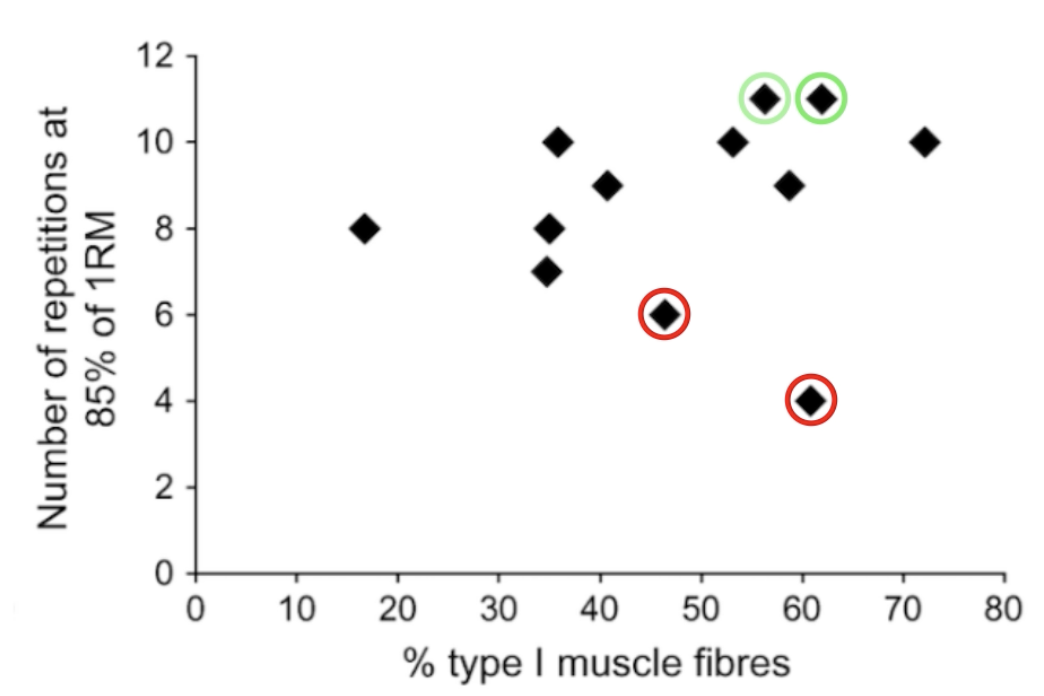
PMID: 18438231
Now RPE partially does solve this problem. If you program RPE 8 or 2 reps in reserve, you can individualize to each athlete.
This gets us closer to a consistent stimulus for each athlete, which should be the goal of an S&C coach.
But VBT takes this one step farther to make the level of stimulus and fatigue associated with training highly precise.
VBT gives you real-time bar speed feedback after every rep, allowing you to coach intent, adjust based on daily readiness, and manage fatigue objectively.
It measures average and peak velocity, range of motion, and power metrics in real time.
For coaches training athletes, this objective data can be incredibly helpful for directing training.
Why OVR Velocity Matters for Athletes
Athletes need the right stimulus based on their phase of training and goals.
Two athletes can both squat 315 at 0.6 m/s.
But:
- Athlete 1 may be in season training power
- Athlete 2 may be off season training for hypertrophy
If you decide to put 80% on the bar (252lbs), here's how you can coach the athletes to achieve power vs. hypertrophy.
Athlete 1: Maximize intent and continue the set until 10% velocity is lost 0.54 m/s
Athlete 2: Maximize intent and continue until 30% velocity is lost 0.42 m/s
Athlete 1 is only training reps that are fast and fresh maximizing power development. He can likely do more sets due to the significantly fewer reps per set.
Athlete 2 will push through a lot more challenging repetitions. This will improve hypertrophy, but does come at the expense of temporarily reducing vertical jump for example for up to ~72 hours.
When you have a tool to measure bar speed you can decide which tradeoffs to make and exactly what stimulus to provide to the athlete.
Because bar speed reflects:
- neuromuscular readiness
- motor unit recruitment
- fatigue accumulation
- Intent
And ultimately what adaptations your athletes will get from training.
This is just one example of how to use the OVR Velocity VBT device.
You can also use it to help determine which athletes are more force deficient vs. velocity deficient to determine how much weight each athlete needs to train, based on their individual deficits.
There's a growing body of velocity based training research and coaches will continue to refine best practices with the device.
Ok, so once you get your OVR Velocity? What should you do first?
Step 1: Set Up the Device Correctly
The setup is one reason OVR has become so useful for coaches. It’s fast and practical. The device magnetically attaches to a plate or rack and the tether straps to the barbell, pairing instantly with the app.
Best setup practices:
- Attach the base to a small plate, micro plate, or rack
- Make sure the tether line runs straight vertically
- Avoid angled tether positions
- Keep bar path consistent
- Use the same setup each week for testing lifts
For team settings, I recommend assigning one athlete to be the velocity captain who handles setup.
This keeps the flow fast.
Step 2: Use Velocity to Pick the Right Load for the Day
This is where OVR becomes extremely powerful.
Instead of saying:
“Everyone uses 85% today”
you can coach based on what the athlete can actually express today.
Example:
Your athlete normally squats 225 at 0.65 m/s.
Today warm-ups show:
- 135 = slower than usual
- 185 = slower than expected
- 225 = only 0.55 m/s
That’s immediate evidence they may be:
- under-recovered
- stressed
- fatigued from practice
- not neurologically fresh
So instead of forcing the load, you adjust until the target velocity zone is achieved.
This is autoregulation.
Just ensure that there is consistent high intent and energy in the weight room.
VBT only works if you have maximal intent!
Step 3: Consider "Velocity Zones"
This is one practical way to direct the type of stimulus and adaptation you can expect from training.
Are you training for vertical jump and speed?
Consider:
Power / Speed Strength
Best when average velocity stays roughly:
- 0.75–1.0+ m/s
Use for:
- dynamic effort squats
- Olympic lift derivatives
- jump squats
- trap bar jumps
- bench throw variations
Goal:
Maximum intent, minimal fatigue
Just need to get Strong?
Strength:
Best when velocity is roughly:
- 0.50–0.75 m/s
Use for:
- squats
- bench
- trap bar deadlift
- split squat strength work
Goal:
High force without unnecessary grind
Hypertrophy / High Fatigue
Usually:
- 0.30–0.50 m/s
This is useful in offseason blocks, but for athletes this should be used strategically, not everywhere.
Because fatigue cost rises quickly.
Remember though, these zones are a general target and you can get "Power" adaptations even in the "strength zone" if your intent is high and your velocity loss cutoff is low.
Step 4: Use Velocity Loss to End Sets
This is personally my favorite aspect of VBT with the OVR Velocity.
The fastest rep of your set (usually within the first 2-3 reps) is your high point.
You can then program a velocity loss cutoff from that.
For example:
First rep = 0.70 m/s
Suggested velocity loss cutoffs
- Power: stop at ~10% loss → 0.63
- Strength: stop at ~20% loss → 0.56
- Hypertrophy: stop at ~35% loss → 0.46
This lets the athlete’s actual performance determine volume.
This is far better than rigidly assigning 5 reps when some athletes should stop at 3 and others can hit 6.
This is especially powerful for:
- in-season athletes
- return to play
- speed-focused blocks
- high/low CNS planning
Step 5: Use It to Improve Athlete Intent
One underrated benefit:
Athletes like to compete.
The second they see:
0.78
0.81
0.84
effort changes.
They attack the bar.
Real-time feedback consistently improves intent, motivation, and performance.
For your athletes, this works great with:
- leaderboards
- “best rep wins”
- contrast training
- sprint + lift pairings
- jump competitions
Athletes like hitting PRs and seeing improvement in objective outputs.
The OVR Velocity gives them the chance to do that every training session.
Step 6: Use It to Track Progress Without Maxing Out
This is huge for private facilities and online coaching.
Instead of frequent 1RM testing:
Ask:
- Is 275 moving faster than last month?
- Did velocity loss improve?
- Is peak power improving?
- Can the athlete maintain speed longer?
This shows progress without fatigue-heavy 1RM testing.
Best Exercises to Use with OVR Velocity
Some of favorite lifts:
Lower body
- trap bar deadlift
- front squat
- back squat
- split squat
- jump squat
Upper body
- bench press
- overhead press
- push press
Explosive
- hang clean pull
- olympic lift derivatives
- trap bar jumps
The more stable and repeatable the bar path, the better the data.
Final Thoughts
OVR Velocity Training Device gives coaches something we’ve always wanted:
objective rep quality
It helps you:
- autoregulate load
- coach intent
- control fatigue
- individualize volume
- improve buy-in
- make better day-to-day decisions
For athletes, that means better results and less wasted volume.
Use our affiliate link here to support The Movement System with your OVR Velocity purchase:
That discount works great whether you’re picking up:
- OVR Velocity for VBT
- OVR Jump for vertical jump and RSI
- OVR Sprint timing gates
- Coach packs for team settings
The standard price for OVR Velocity Training Device is around $249, which is already an incredible deal for a VBT device. Saving $25 extra makes OVR Velocity by far the best-value VBT devices on the market.
If you get one, make sure to tag me on IG when you're using it and I'll do my best to repost you.
Stay connected with news and updates!
Join our mailing list to receive the latest news and updates from our team.
Don't worry, your information will not be shared.
We hate SPAM. We will never sell your information, for any reason.
